Perimenopause Skin Changes: Complete Skincare Guide for Women 40+
Perimenopause produces some of the most dramatic skin changes of any life stage besides puberty — and most mainstream skincare advice is still written for 25-to-40-year-old skin. If your skin has suddenly started feeling drier, more reactive, or less “bouncy” than it used to, the explanation usually comes down to one hormone: estrogen.
Why estrogen decline changes your skin
Estrogen-related skin changes: Estrogen and skin review (PubMed); AAD menopause skin care.
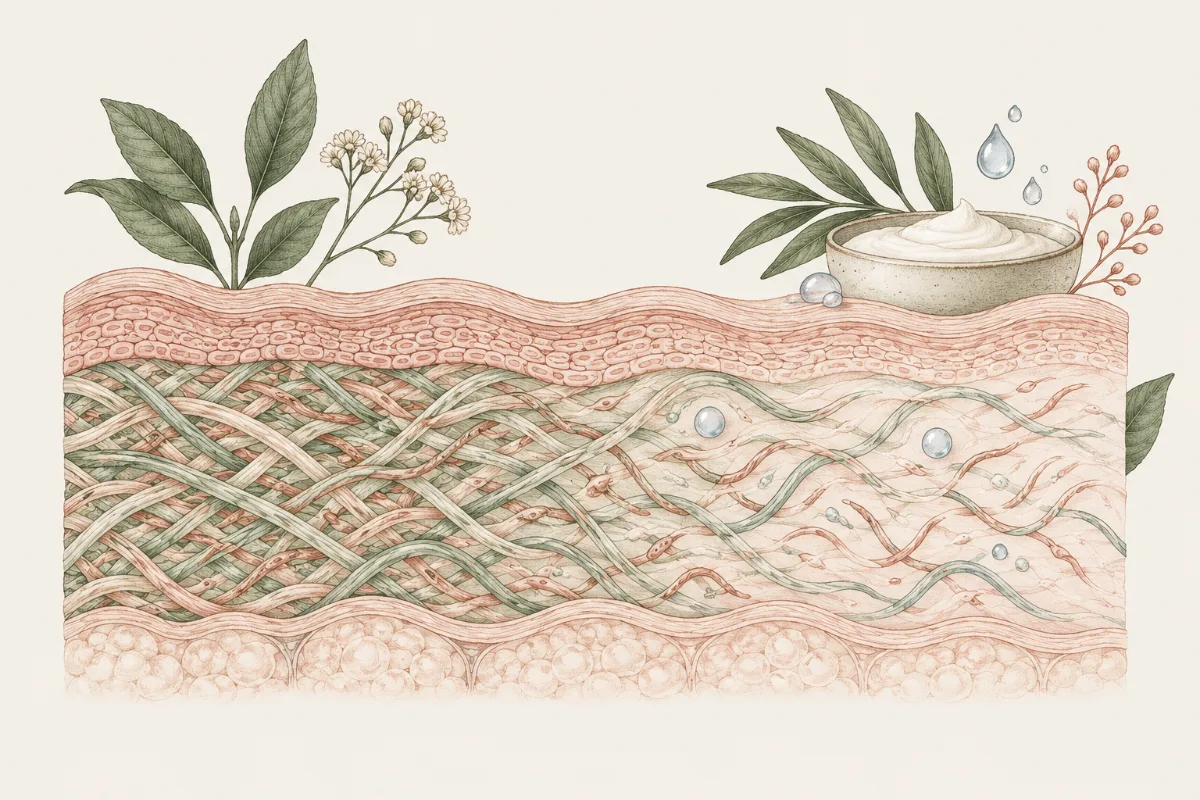
Skin is an estrogen-sensitive organ. Estrogen receptors sit on the fibroblasts (the cells that build collagen), on keratinocytes, and on the glands that produce your skin’s natural oils. As estrogen production becomes erratic and then declines through perimenopause, several things happen at once:
- Collagen production slows. Research published in peer-reviewed menopause and dermatology journals consistently finds that women lose around 30% of their skin’s collagen in the first five years after menopause, with a further ~2% loss each year after that — a steeper drop than the roughly 1–1.5% annual decline that begins even earlier, in your 30s.
- The skin barrier weakens. Estrogen supports ceramide production, so as it drops, skin holds onto moisture less effectively.
- Sebum production drops, alongside falling testosterone, which is part of why skin that was oily for decades can suddenly feel dry.
- Blood supply to the skin decreases, which is part of why redness, flushing, and a duller complexion become more common.
None of this is cosmetic-only — thinner, less elastic skin is also more prone to irritation from products that never used to bother you.
The five changes women notice most
1. Dryness
Often the first and most noticeable change. Covered in depth in Why Is My Skin So Dry in Perimenopause?
2. Sensitivity and redness
Skin that tolerated actives for years can suddenly react to them. See Perimenopause Skin Sensitivity and Redness — and if what you’re dealing with sounds more like genuine barrier damage (stinging, flaking, tightness), our Skin Barrier Repair guide is the more precise fit.
3. Breakouts returning
Some people develop acne during the menopausal transition, while others notice dryness or sensitivity. Hormonal changes may contribute, but acne has multiple causes and this pattern alone does not identify the cause. If acne is persistent, painful, or scarring, a dermatologist can discuss treatment options. For more context, see our Hormonal Acne guide and Perimenopause Acne Breakouts.
4. Pigmentation and uneven tone
Covered in Perimenopause Dark Spots and Hyperpigmentation.
5. Loss of firmness and elasticity
The direct result of the collagen decline described above. Covered in Skin Firmness and Elasticity in Perimenopause.
Building a perimenopause skincare routine
Skin care and the evidence for prescription tretinoin: AAD menopause skin care; Tretinoin trial review (PubMed).
The instinct to “fight” these changes with a more aggressive routine usually backfires — thinner, more reactive skin needs a routine built around support, not intensity. For a full step-by-step version, see Perimenopause Skincare Routine. In outline:
- A gentle, hydrating cleanser — avoid anything that leaves skin feeling tight or squeaky-clean
- A treatment step, introduced slowly — retinoids remain one of the best-evidenced options for collagen support, but perimenopausal skin often needs a lower strength or less frequent use than it once did (see Is Retinol Safe During Perimenopause?)
- A rich, barrier-supporting moisturizer — see our full product roundup: Best Moisturizer for Perimenopausal Skin
- Daily SPF — sun damage compounds every other change described here, and pigmentation in particular
Ingredients with real evidence for this life stage
| Ingredient | Why it helps | A product to know |
|---|---|---|
| Ceramides + cholesterol + fatty acids | Rebuilds the weakening lipid barrier | SkinCeuticals Triple Lipid Restore 2:4:2 |
| Peptides | Signal fibroblasts to support collagen | IMAGE Skincare Vital C or Ageless lines |
| Niacinamide | Boosts the skin’s own ceramide production, evens tone | La Roche-Posay Toleriane Double Repair |
| Broad-spectrum mineral SPF | Prevents further collagen breakdown and pigmentation | Colorescience Total Protection sunscreens |
Related Dermlore guidance
Products mentioned in this guide
Dermlore may earn a commission from qualifying purchases made through links on this page, at no additional cost to you. As an Amazon Associate I earn from qualifying purchases.
- CeraVe Moisturizing Cream, Face & Body Moisturizer for Dry Skin, 19oz — CeraVe · 19 oz. Face and body cream with ceramides; 19 oz.
- CeraVe Hydrating Mineral Sunscreen SPF 30 with Hyaluronic Acid, 2.5oz — CeraVe · 2.5 oz. Mineral face sunscreen labeled SPF 30; 2.5 oz.
- La Roche-Posay Toleriane Hydrating Gentle Facial Cleanser, with Niacinamide — La Roche-Posay · 13.52 fl oz. Hydrating facial cleanser with niacinamide; 13.52 fl oz.
A note on topical estrogen
U.S. regulatory status and limited topical-estrogen evidence: FDA menopause guidance; FDA compounding guidance; Small topical-estrogen study (PubMed).
Facial estriol is not an FDA-approved skin-aging treatment in the U.S. Small studies of topical estrogens do not establish long-term safety or effectiveness for every preparation. Compounded hormones are not FDA-approved. Do not assume skin application means no systemic absorption. See our topical-estriol evidence review and discuss any proposed hormone use with a qualified clinician.
Perimenopause vs. menopause: does it matter which one you’re in?
Perimenopause is the transition — typically starting in your 40s (sometimes mid-30s), marked by irregular periods and fluctuating hormones. Menopause is defined as 12 consecutive months without a period. Skin changes generally continue on the same trajectory through both, though the estrogen decline — and collagen loss — accelerates further once you’re postmenopausal. See Perimenopause vs. Menopause Skin Changes for the full comparison.
FAQ
Can skincare alone reverse perimenopausal skin changes?
No topical product replaces the estrogen your skin has lost, but a barrier-focused, peptide-and-retinoid routine can meaningfully slow visible changes and improve comfort. For a bigger intervention, that’s a conversation about hormone therapy to have with your doctor, not a skincare decision.
Why did my skin type seem to change overnight?
It’s rarely truly overnight, but hormonal shifts during perimenopause can happen quickly enough that changes feel sudden — especially the drop in oil production if you were oily-skinned for most of your life.
Should I stop using retinol if my skin feels more sensitive now?
Not necessarily — but you may need to adjust frequency or pair it more deliberately with barrier-support products. See Is Retinol Safe During Perimenopause? for specifics.
More perimenopause skin guides
References
- Estrogen and skin: therapeutic options American Journal of Clinical Dermatology · 2011
- Caring for your skin in menopause American Academy of Dermatology
- Topical tretinoin for treating photoaging: A systematic review of randomized controlled trials International Journal of Women’s Dermatology · 2022
- Menopause U.S. Food and Drug Administration
- Compounding and the FDA: Questions and Answers U.S. Food and Drug Administration
- Treatment of skin aging with topical estrogens International Journal of Dermatology · 1996
Dermlore provides general educational information, not personal medical advice, diagnosis or treatment. Reading this site does not create a doctor–patient relationship. Consult a qualified healthcare professional for advice about your circumstances. Medical disclaimer.