Hormonal Acne in Adult Women: Causes, Treatment & Skincare Guide
Adult acne can persist or first appear well beyond the teenage years. Hormonal factors can contribute, but acne has multiple causes and a breakout pattern alone does not establish abnormal hormone levels. This guide explains evidence-based treatment options and when assessment is needed.
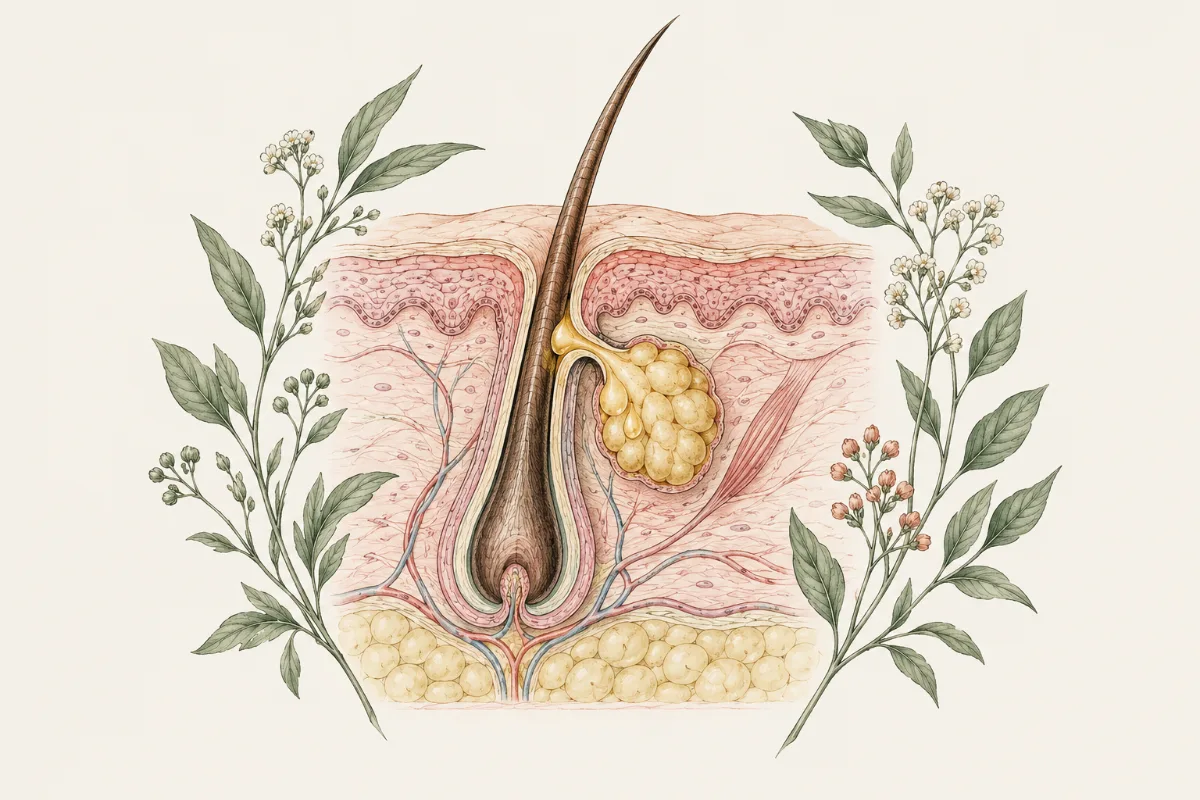
This guide covers what’s actually happening in your skin, how to tell hormonal acne apart from other breakouts, and what genuinely helps — from over-the-counter ingredients to when it’s worth asking a dermatologist about prescription options.
What makes acne “hormonal”
Acne mechanisms and adult presentation: 2024 acne guideline (PubMed); Menopausal acne review (PubMed).
Every case of acne has a hormonal component — androgens (a group of hormones present in everyone) drive oil (sebum) production in the skin’s pores, and excess sebum combined with dead skin cells and bacteria is what clogs a pore and starts a breakout. What we usually mean by “hormonal acne” is breakouts tied to fluctuations in that hormonal picture rather than a steady baseline: around your period, after stopping birth control, during pregnancy, with PCOS, or during the hormonal shifts of perimenopause.
Cleveland Clinic describes hormonal acne as breakouts that form in adulthood, ranging from blackheads and whiteheads to deeper, painful cysts, and notes it typically affects adults between 20 and 50. Interestingly, research on acne around the menopause transition has found that androgen levels in these women are often still within a normal range — it’s the falling estrogen relative to androgens that shifts the ratio enough to stimulate the sebaceous glands and trigger flares.
Signs your acne may be hormonal
- Breakouts concentrated on the lower face — jawline, chin, and around the mouth
- Deep, tender bumps rather than surface-level whiteheads
- A pattern tied to your cycle, flaring in the week before your period
- Onset or return of acne well into your 20s, 30s, or 40s after clear skin as a teenager
- Breakouts that showed up or worsened after starting, switching, or stopping hormonal birth control
For a closer look at how this compares to the acne you may have had as a teenager, see our guide on hormonal acne vs. teenage acne.
When to see a dermatologist
Over-the-counter approaches (covered below) are a reasonable starting point for mild, occasional breakouts. It’s worth booking a dermatology visit if you notice:
- Deep, painful cysts or nodules that leave marks or scars
- Acne that hasn’t responded to 2–3 months of consistent OTC treatment
- Breakouts alongside other signs sometimes linked to PCOS — irregular periods, excess facial or body hair, scalp thinning
- Acne that’s affecting your confidence or daily life — this is a legitimate reason on its own
A dermatologist can also discuss prescription options not covered in detail here, including topical or oral antibiotics, hormonal therapies, and isotretinoin for severe cases.
Building a skincare routine for hormonal acne
Treatment options and gentle skin care: 2024 acne guideline (PubMed); AAD acne skin care.
A gentle, consistent routine matters more than an aggressive one — over-stripping the skin often triggers more oil production, not less. For the full step-by-step version, see Best Skincare Routine for Hormonal Acne. The short version:
- Cleanse gently, twice a day. Avoid harsh foaming cleansers that leave skin feeling tight.
- Treat with one active ingredient at a time. Introducing several new actives at once makes it hard to tell what’s working — and raises your risk of irritation.
- Moisturize, even if you’re oily. Skipping moisturizer can worsen breakouts by disrupting the skin barrier.
- Never skip SPF, especially if you’re using acne actives — many increase sun sensitivity.
Real ingredients with evidence behind them
| Ingredient | What it does | A product to know |
|---|---|---|
| Adapalene (retinoid) | Normalizes cell turnover, prevents clogged pores | Differin Gel 0.1% — the first FDA-approved OTC retinoid for acne in the U.S. (FDA approval) |
| Azelaic acid | Anti-inflammatory; may help fade post-acne marks; tolerability varies by formulation | The Ordinary Azelaic Acid Suspension 10% |
| Salicylic acid (BHA) | Exfoliates inside the pore, reduces clogging | Paula’s Choice 2% BHA Liquid Exfoliant |
| Benzoyl peroxide | Reduces acne-causing bacteria | La Roche-Posay Effaclar Duo |
Related Dermlore guidance
We break each of these down in more depth, including how to combine them without irritation, in Azelaic Acid for Hormonal Acne and the full skincare routine guide.
Products mentioned in this guide
Dermlore may earn a commission from qualifying purchases made through links on this page, at no additional cost to you. As an Amazon Associate I earn from qualifying purchases.
- Vanicream Gentle Facial Cleaner, pH-Balanced Face Wash, 8 Fl Oz — Vanicream · 8 fl oz. Fragrance-free facial cleanser; 8 fl oz.
- CeraVe PM Daily Facial Moisturizer, Skin Care for Dry Skin, Oil-Free, 3oz — CeraVe · 3 oz. Facial lotion with ceramides; 3 oz.
- CeraVe Hydrating Mineral Sunscreen SPF 30 with Hyaluronic Acid, 2.5oz — CeraVe · 2.5 oz. Mineral face sunscreen labeled SPF 30; 2.5 oz.
What tends to make hormonal acne worse
Diet evidence and avoidable irritation: Dairy meta-analysis (PubMed); 2007 diet trial (PubMed); AAD acne habits guidance.
- Diet: the evidence is still evolving, but some research links high-glycemic diets and dairy to acne flares in some people. This isn’t a guarantee it applies to you — see our full breakdown in Does Diet Affect Hormonal Acne?
- Stress: stress hormones can increase oil production
- Picking or popping: raises the risk of scarring and post-inflammatory marks — see How to Fade Acne Scars and Dark Marks
- Over-exfoliating or over-cleansing: damages the skin barrier, which paradoxically can worsen breakouts. If your skin feels raw, tight, or stings when you apply products, that’s a different (and related) problem — see our Skin Barrier Repair guide
Hormonal acne through different life stages
Hormonal acne doesn’t look the same at every age:
- In your 20s and 30s, it’s often tied to your menstrual cycle or birth control status — see Birth Control and Acne
- With PCOS, it tends to be more persistent and concentrated on the jawline — see PCOS Acne Treatment
- In your 40s and into perimenopause, breakouts can return even if you had clear skin for years — see Menopause Acne Causes and our full Perimenopause Skin Care Guide for the bigger picture of what’s changing
FAQ
Can hormonal acne go away on its own?
For some people, breakouts ease once hormones stabilize (for example, a few months after starting or stopping a medication). For others, it persists until it’s actively treated.
Is hormonal acne the same as cystic acne?
Not always, but they overlap. Hormonal acne is often cystic (deep, painful bumps under the skin) because of how it forms, but you can have hormonal acne that’s milder.
Does spironolactone work for hormonal acne?
It’s a prescription option some dermatologists recommend for adult women, particularly with jawline-pattern acne. We cover how it works and realistic timelines in our spironolactone guide — this is a prescription decision to make with your doctor, not something to start on your own.
More hormonal acne guides
References
- Guidelines of care for the management of acne vulgaris Journal of the American Academy of Dermatology · 2024
- Menopausal Acne - Challenges And Solutions International Journal of Women’s Health · 2019
- Acne: Tips for managing American Academy of Dermatology
- Dairy Intake and Acne Vulgaris: A Systematic Review and Meta-Analysis of 78,529 Children, Adolescents, and Young Adults Nutrients · 2018
- A low-glycemic-load diet improves symptoms in acne vulgaris patients: a randomized controlled trial American Journal of Clinical Nutrition · 2007
- 10 skin care habits that can worsen acne American Academy of Dermatology
Dermlore provides general educational information, not personal medical advice, diagnosis or treatment. Reading this site does not create a doctor–patient relationship. Consult a qualified healthcare professional for advice about your circumstances. Medical disclaimer.