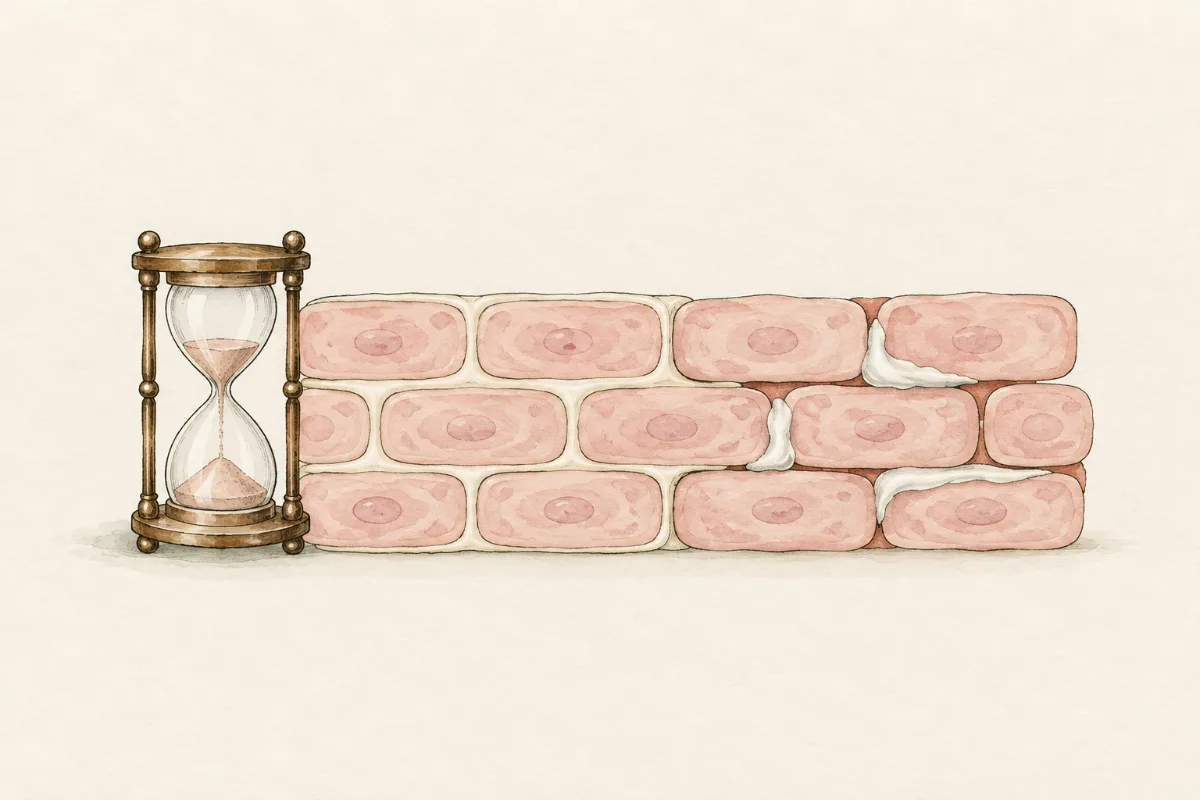
How Long Does It Take to Repair a Skin Barrier?
This is the question almost everyone asks once they realize their skin barrier is compromised — and the honest answer depends on how significant the damage is.
The general timeline
Recovery depends on cause and treatment; no fixed universal schedule: AAD dermatitis diagnosis and treatment.
There is no validated universal two-, four- or six-week recovery schedule for “barrier damage.” Cause, continued exposure and conditions such as dermatitis change the course. Improving comfort does not prove that the lipid matrix is fully restored. Seek assessment if symptoms persist or worsen; do not wait for a calendar deadline when there is substantial pain, swelling, oozing or a spreading rash.
What actually affects your specific timeline
- How the damage happened. A single harsh product reaction tends to resolve faster than months of cumulative over-exfoliation
- How quickly you simplify your routine. Continuing to use even one irritating product significantly slows recovery
- What you’re using during recovery. A moisturizer combining ceramides, cholesterol, and fatty acids together outperforms a single-ingredient product — see Best Ingredients for Skin Barrier Repair
- Your skin’s baseline. Some skin types and life stages (like perimenopause, when the barrier is already under hormonal strain) may take longer to recover than others
Products mentioned in this guide
Dermlore may earn a commission from qualifying purchases made through links on this page, at no additional cost to you. As an Amazon Associate I earn from qualifying purchases.
- CeraVe Moisturizing Cream, Face & Body Moisturizer for Dry Skin, 19oz — CeraVe · 19 oz. Face and body cream with ceramides; 19 oz.
- Vanicream Daily Facial Moisturizer, Lightweight, Non-Greasy, 3 Fl Oz — Vanicream · 3 fl oz. Facial lotion listing ceramides and hyaluronic acid; 3 fl oz.
Signs recovery is progressing, even before it “looks” better
Comfort and dry-skin management: AAD dry-skin care.
Subjective comfort — less stinging, less tightness — often improves before visible texture changes. This is a useful early signal that your routine is working, even if your skin doesn’t look dramatically different yet.
Related Dermlore guidance
When to worry that it’s taking too long
If you’ve followed a genuinely simplified, barrier-focused routine (see the full Skin Barrier Repair Routine) consistently for 4–6 weeks without improvement, or symptoms are getting worse rather than better, that’s a reasonable point to see a dermatologist. This could indicate an underlying condition — eczema, contact dermatitis, or rosacea — that needs a different treatment approach than straightforward barrier repair.
Why rushing the process backfires
Repeated exposure to an irritant can prolong symptoms. Recovery is not governed by a literal clock, and the cause should be reassessed if the simplified approach does not help.
FAQ
Can I speed up recovery with more products?
No — this is one of the most common mistakes. Adding more “treatment” products, even gentle ones, usually slows recovery rather than speeding it up. Less is genuinely more during this phase.
Will my skin go back to exactly how it was before?
Usually, yes, once the barrier fully rebuilds — barrier damage is generally reversible, unlike some other skin conditions, which is part of why the simplify-and-wait approach works.
Is it normal for recovery to take longer than 6 weeks?
It can happen, especially with more chronic or severe damage — but if you’re well past 6 weeks with a genuinely consistent, simplified routine and seeing no improvement, that’s worth a professional evaluation rather than continuing to wait.
References
- Eczema types: Contact dermatitis diagnosis and treatment American Academy of Dermatology
- Dermatologists’ top tips for relieving dry skin American Academy of Dermatology
Dermlore provides general educational information, not personal medical advice, diagnosis or treatment. Reading this site does not create a doctor–patient relationship. Consult a qualified healthcare professional for advice about your circumstances. Medical disclaimer.