Perimenopause Dark Spots and Hyperpigmentation
Dark spots during the menopausal transition can have several causes, including melasma, post-inflammatory pigmentation and sun-related changes. Timing alone does not establish that perimenopause caused them; diagnosis matters before choosing treatment.
Why pigmentation changes at this life stage
Melasma has multiple contributing factors: Melasma pathogenesis review (NCBI).
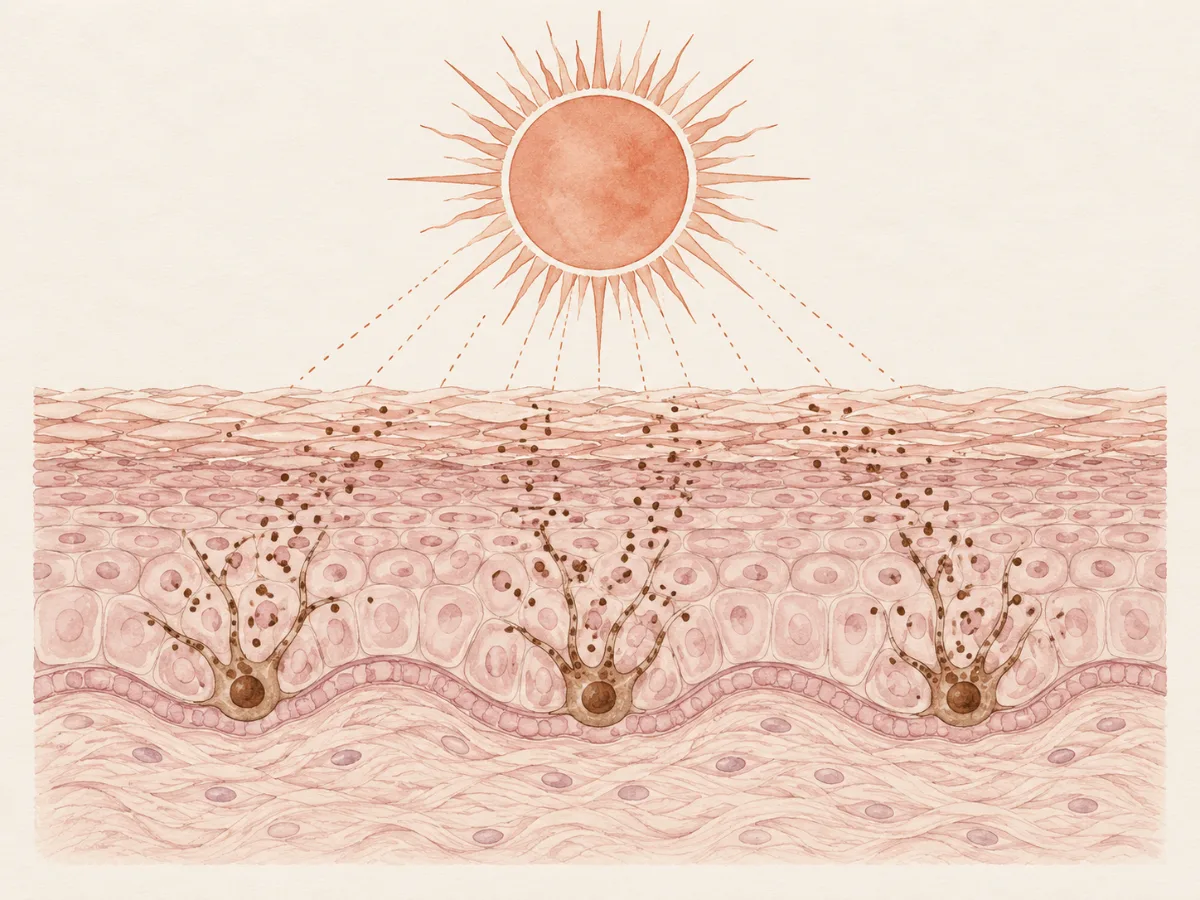
Melasma is a pigment disorder with interacting hormonal, genetic and light-related factors. A new dark patch in midlife is not automatically melasma or a consequence of declining estrogen. Sun spots and post-inflammatory marks have different causes and may need different treatment.
What actually helps
Selected topical treatment evidence; not all dark spots are equivalent: 15% azelaic-acid trial (PubMed); Tretinoin trial review (PubMed).
Consistent sun protection is central. A dermatologist can identify the type of pigmentation and select treatment. Trials support selected azelaic-acid preparations for post-acne marks and prescription tretinoin for some photoaging-related pigmentation; those results are not interchangeable with every OTC product or every form of melasma. For confirmed melasma, a dermatologist may consider a prescription triple-combination cream containing hydroquinone, a retinoid and a corticosteroid; in the U.S., Tri-Luma is FDA-approved for short-term treatment of moderate-to-severe facial melasma and should be used under medical supervision.
Azelaic acid and retinoids can cause irritation. Introduce treatments according to their directions and seek advice if redness or stinging persists. See post-acne marks and retinoid tolerability.
Realistic expectations
Response varies with the diagnosis, treatment and depth of pigment. Improvement may take months, and melasma can recur. A fixed 8–12-week prediction is not reliable for every dark spot. Review the plan with a clinician rather than repeatedly adding stronger products.
When to see a dermatologist
Seek assessment for an uncertain diagnosis, a changing or unusual spot, or persistent pigmentation. Procedures require individual selection; they are not guaranteed to work faster and can worsen pigmentation in some circumstances.
FAQ
HRT association is based mainly on case reports: 2026 HRT–melasma evidence review (PubMed).
Is pigmentation during perimenopause always melasma?
No. Melasma, sun spots and post-inflammatory marks are distinct possibilities, and examination may be needed.
Can hormone therapy help with pigmentation?
HRT is not an established treatment for pigmentation. A 2026 review found evidence about HRT-associated melasma was limited and mainly case reports, with differences between formulations. This does not prove that HRT causes melasma in every user. If pigmentation changes during treatment, discuss it with your prescriber; do not start or stop HRT solely on the basis of this article.
Can sun exposure worsen pigmentation?
Light exposure can worsen melasma and some other pigment disorders. Consistent protection is part of management, but it does not replace diagnosis.
References
- Update on Melasma—Part I: Pathogenesis Dermatology and Therapy · 2022
- Effects of 15% Azelaic Acid Gel in the Management of Post-Inflammatory Erythema and Post-Inflammatory Hyperpigmentation in Acne Vulgaris Dermatology and Therapy · 2024
- Topical tretinoin for treating photoaging: A systematic review of randomized controlled trials International Journal of Women’s Dermatology · 2022
- Does Hormone Replacement Therapy Influence Melasma Development? A Review of the Evidence and Management Guidelines Dermatologic Surgery · 2026
Dermlore provides general educational information, not personal medical advice, diagnosis or treatment. Reading this site does not create a doctor–patient relationship. Consult a qualified healthcare professional for advice about your circumstances. Medical disclaimer.